Wednesday, April 14, 2010

Canyon de Chelly Revisited


Yesterday I posted last weekend's trip to Canyon de Chelly and a number of people sent kind words and asked for more information and pictures on this remarkable remote spot within the Navajo reservation in Northeastern Arizona.

Even as I include a few more shots today, these scarcely does this amazing historical and geologically fascinating scenic site justice. Also I prefer a paucity of words to best convey a feeling of essence rather than relating facts which can be found on other sites.

By enlarging the first photo you may see a sheer rock face with a cave which marks the location of the "White House" ruins. The second photo, taken from the floor, shows the ruins peaking around the corner. The last photo is of only small part of the more than 60 rooms remaining from the Anasazi community who constructed homes here between 1040 and 1275A.D. I chose this photo because of the figure prominently displayed in the rock. I think it is a sign of welcome to those who come in peace. It greets you today and perceives the love in your heart.

Btw, the cactus in yesterday's post is called "Cholla" and, along with "Prickly Pear," is in abundance along the trail.

Tuesday, April 13, 2010

Canyon de Chelly Viewpoint?


I took many photos at Canyon de Chelly near Chinle, Arizona, and, as I review them, I am even now more amazed at the grace and beauty I experienced last Saturday afternoon. Instead of posting some of the more well-known scenes, I decided today to show some detail that may not appear into the numerous sites which promote this historic location.

At first I thought that possibly the effort to reach this isolated spot in the heart of Navajo country in Northeastern Arizona contributed to its mystique, but now I don't think so. This quietly dramatic, natural setting exuded a sacred energy which, by its sheer simplicity, eclipsed, in my opinion, the power of the Grand Canyon. Here, within its rocks, were the remains of homes and wall paintings of early peoples that reminded me of the once living and whose voices I easily imagined carried by the wind.

The first photo, taken through a rock window, shows a hogan on the canyon floor used today by sheep or goat herders perhaps during cold weather. Navajos use the land for grazing and for recreational horseback riding. It is an organic part of the reservation and not banalized as a separate entity defined by gates, fees, and concession stands, which is typical of national park status.

It is early Spring here and many cacti are in bloom. Creeks are gurgling with snow run-off and trees show signs of new leaves. In this environment of wildly fluctuating temperature and fine red dusty sand, adaptation takes so many forms. I included the second and third photo to add a touch of color which might help convey the tenacity of the plants I found along the 2 1/2 mile trail.

The last photo looking East is purely to let your eyes and mind explore a small section of this glorious place. Perhaps you will find a painting drawn near a crevice or by a cave entrance. Will it be of an eagle or a coyote or merely a puzzling symbol reflecting an innermost thought? Only you will know!

Monday, April 12, 2010

It's not New York!


This weekend my host family took me to Lukachukai, Arizona, near the heart of the Navajo Nation, where I had some of the most energizing and fascinating experiences of my Amizade adventure
In this most remote part of the state, live pockets of native people who eek out their existence in a constant struggle with blowing dust, vastly varying temperatures, little work and many of the other typical malaises associated with poverty. Yet, the people I met were rugged in character and complexion and projected a pride, deeply rooted in a love of this vast powerful and spiritually-filled landscape.

The second photo shows the sandy, dusty red landscape where people homestead. The especially large hogan may be a house, storage building or a sweat lodge. Most places are much smaller, often consisting of a run down trailer,a shed, and some broken down cars.

The last photo is of Round Rock., outside a tiny community of the same name, where last night I attended a tradtional song and dance evening. Local people meet in the school gym to sing native songs, drum, and dance. It is a wonderfully gentle, graceful affair where residents old and young dress up in local costume or in nice clothes to dance in a slow circular motion around the room in a heel tap fashion to the voices of other neighbors. I was asked to join and felt comfortable even though I was clearly the only person there who was not Navajo. I did record video and sound which I will be glad to share at a later date.

I am bursting with thought and am also so eager to post about Canyon de Chelly, which was even more dramatic than I expected. I am fatigued today by the intensity of my days. I just came from a day at school and have only a few moments to post before I leave with my host family for a "short" 75 mile trip to Flagstaff for some shopping. "The distances here are staggering" I remarked, but my host laughed and explained wryly, that here it's just another day.

Friday, April 9, 2010

The final adventure-Tuba City


It is always hard to know where to begin. After a long flight from Jamaica to Phoenix, I drove the next morning slowly North to my next Amizade site, The Navajo Nation in Tuba City, Arizona. I took a side trip to Prescott and then followed the scenic trail through Jerome, and Sedona to Flagstaff. As twilight approached, heading through a desolate moonscape, I past the turn-off for most tourists, namely the road to the Grand Canyon, and then found myself on a lonely stretch of highway, which led me to Tuba City.

The top photo taken from inside the quad of the Tuba City Boarding school where I spent my first day with 8th graders in the culture class. This school is a federally funded K-8 school which must have 90% Navajo enrollment and has almost 1200 students, some who live on campus, but the majority live at home with their families. Some of the children are from entirely Navajo speaking families and like my host family, speak their native language fluently. Like in all of the previous sites, I was again totally among people who were not white, and conversed in a language I did not understand, except this time I was in America!

I chose the second photo to verify how ethnic this location is. This older lady, who only spoke Navajo, allowed me to take her picture. She was selling a few handmade beaded items at an open air market I visited this afternoon with my host. This was not a tourist spot but a place where local people bought household items and food. I bought some beaded bracelets and earings from her that I hope my family members will appreciate. I can not vouch for the quality, but I felt great not shopping in the many "trading outposts" I saw loaded with tourists on my way here.

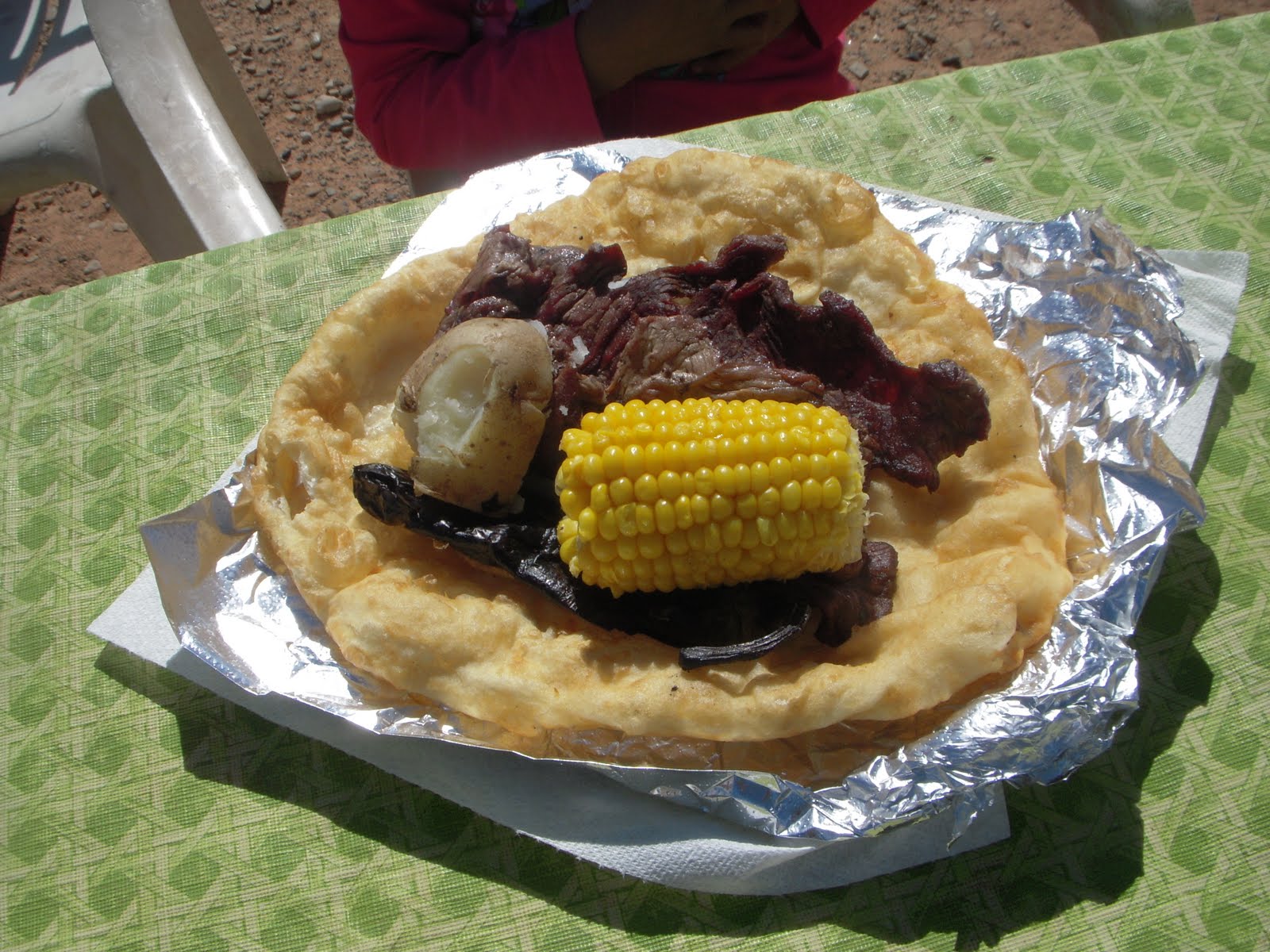
The third photo was a necessity to include. What would a first day be on the reservation without a traditional meal of mutton and fry bread! I sat on a long table with my host family who initiated me into the tribe by buying me this plate. By the way, under the corn is a long fried green pepper. In each country I have visited I have been treated to the local "delicacy" and this is one of the finest and complicated parts of the adventure, namely to eat healthily. I praised the meal to my hosts, although I'm sorry to admit that I have eaten so many carbs these past months that the paunch I so so struggled to remove last year, is again reappearing.

Instead of going to the Grand Canyon this weekend, my family is taking me on a special journey to Canyon de Chelly, a National Park which is allegedly so beautiful, private, and deep in Navajo country. There is also supposed to be a local music and songfest in a nearby community. My host's husband is from that region and has built a small cabin in the mountains where we will stay. I had to laugh when I was asked whether I minded that it had no running water or indoor plumbing! What else is new? Been there, and still doing that!

Tuesday, April 6, 2010

My Jamaican Mothers


For the past two weeks I have been a guest of Ms. Paulette McKenzie and her mother, Dorothy. My adopted parents have been feeding me, doing my laundry, and have kept me on schedule. I believe it has been quite a challenge and this post is a tribute to them and a way to express my heartfelt appreciation. I know that I am not alone in my feelings. All the Amizade volunteers here in Petersfield, Jamaica are taken in by host families and are given incredible care. It is a credit to the program here that all the Americans are made to feel so welcome.

I am certain that it has not been entirely easy for these ladies to have me. I am referred to by many as a free spirit. I tend to roam the streets and go off on my own in search of adventure and have been somewhat hard to supervise. I think that the two women simply decided that I could find my way home and finally gave up worrying. I feel today like a part of their family and will miss them, including their nephew Roman and son Robert Jr.

One of the true benefits of the Amizade adventures is that the experience thrusts the volunteer directly into the culture. Some of the finest moments have occurred while sitting at the diningroom table and exchanging stories, or going to the market with a family member and shopping for groceries, or attending community functions and realizing that you are witnessing events and interaction that no regular tourist ever sees.

This is my last afternoon here in Jamaica before leaving for the Navajo Nation in Arizona. I feel so fortunate for having chosen to visit this site and know that the other volunteers have felt the same way.

Saturday, April 3, 2010

High Fives!


The above photos show the WVA students working on the Amizade classroom project in Petersfield, Jamaica.

Tonight their school is in a big basketball tournament in the United States and millions of people will be watching this "Final Four" event. The real heros of the day in my estimation are those who are before you, a team of students dedicating their time and energy to help disadvantaged people from a vastly different culture. For this we should salute the "Mountaineers".

I only have a few minute to post this evening. I will have no connectivity on Easter Sunday and Monday is a national holiday in Jamaica, so I hope to find you on Tuesday. Wednesday is a travel day when I return to the U.S. and head for the Navajo Nation in Arizona.

Thursday, April 1, 2010

A little of this and that.


My photos today have no central theme. This morning our Amizade group toured a sugar cane factory. It was such an intense experience to watch the cane stacked,washed, ground, separated, heated, squeezed and transformed in brown sugar. I saw mountains of sugar, bagged and loaded onto trucks for foreign markets. I have so many thoughts about sugar I hardly no where to begin other than I think it is a terrible product, but more on that some other time. Rather than showing one of the hundred pictures I took of the plant, I liked this last photo of a plant worker resting. It was at least a hundred degrees in the factory, it had an indescribable, noxious odor, and was noisy as hell.

After the tour, the group went to the larger town for some shopping. I left the group and strolled down to the chaotic market. I have so many photos of foods and vendors, but chose this one of a pickup truck bed, because it lumped together in one big pile many of the local foods. How many can you identify?

The top picture of a sign on the seawall of the nearby town, Savanna al Mar, caught my fancy. Like most places, this Jamaican town lacks public bathrooms. I would be cautious and reluctant to use them, even if there were any, but when you have to go, well you have to go. Travelers often tell one another bathroom horror stories and, so far, I've avoided sharing any on my blog. Relieving yourself in any town for a tourist unaccustomed to ruder accomadations is always a challenge. Anyway I walked over to the wall to see the beautiful blue Carribean and unfortunately it wasn't the sea air that caught my attention. So much for civic messages!