Monday, June 30, 2014

Over Madagascar


I  have been home for over a month and practically every day I have opened my notepad and resolved to write a follow-up or concluding chapter of the Madagascar experience. Unfortunately, it feels like my creative juices have run dry. Perhaps I have not  adjusted properly to my normal circumstances.  In any case, I have lost the clarity of mind I felt so vibrantly while I was away. So to help kickstart my brain, I sorted through the more than fifteen hundred photos I took. I listened to the entire CD of authentic Malagasy music Clement, my guide and I recorded. I've reread my previous posts and examined the souvenirs I brought back.  Yet, in spite of the effort, I can not stop the dulling of memories. I am left with vague visions of landscape and animals, imprecise impressions of people, dumb platitudes about Madagascar society, and am out-of-touch with the sounds and odors that made the country distinctive. One experience though does suddenly come to mind and may help me offer at least something I learned.

One morning during the middle of the trip, I was on a private tour of Isalo National Park with a bright young naturalist whose name I no longer recall. We hiked up into high rugged dry terrain of plateaus separated by sheer cliffs of red, yellow, pink and white strata which drop vertically into deep narrow canyons. This topography, known as massifs, is considered to be among the most scenic and dramatic landscapes in the entire country and was not what I expected at all. At first glance, this un-tropical spot looked like it could be mistaken for landscape in Arizona and, if it were not for the presence of mud hut villages and herds of zebu, African oxen, I could see in the distance, one would expect to see road signs measuring distance to Phoenix.  Along the trail the guide and I stopped at viewpoints and scanned the horizon. We shared water and snacks and, interspersed between his narrative about the indigenous plants and animals that we encountered, he spoke, like so many of his type, of his dreams and aspirations to see the world. I had heard such sentiments many times before by others like him on this and other trips. The obstacles these young third world, environmentally conscious, people faced to satisfy their desire to discover the world beyond their neighborhood were numerous. Not only thwarted by impossible financial limitations, commitments to wives, children and extended family to be ever present providers, created a moral dilemma which left these bright curious people frustrated. His tone saddened me and made me feel undeservedly privileged. Exploring the world for me was a passion and a somewhat frivolous hobby, but for my naturalist guide discovery was integral to his identity and career development. He pointed out a "walking stick" on a branch which I had a difficult time spotting, even after he pointed and traced with his finger the insect's outline, and then indicated a small exotic-looking lizard whose head bobbed up and down. Later he told me of the life cycle of the golden-webbed spider.  He explained some of the theories of these animals strange behavior, which he communicated enthusiastically in English, but have could have done so as easily in French, German or Malagasy. The sun was now high in the sky and we reached the edge of a precipice. The view was expansive. I suddenly felt faint and overloaded from the rigors of travel and need to rest. Surrounded by ancient geologic Cambrian formations teeming with trilobite, ammonite and pre-dinosaur fossils, I lay down on my back, rested a bottle of water on my belly, dangled my feet over the edge, and looked up at the sky. I saw shapes in the clouds that looked like people I had known. I recalled the faces of my parents, sister, children and intimate friends and took an assessment of my life. My guide let me lie there for perhaps a half an hour or longer and made no effort to interrupt my reverie. He stood quite some distance away in the shade of a hillock. I winced from the pain of some recollections and felt gratitude for the imbalance of my life's positive fortune. It was then that I realized I had the ability to help a deserving young naturalist expand his experience and help him tour America in order to derive the benefits of world travel as I have.

I couldn't help that guy. He had committed himself  to a five year contract with his park service and also his wife had a second child due, but I have subsequently  made efforts to foster someone else. I have offered to pay a round trip ticket for a deserving fellow from Colombia I met several years ago to spend a month here. It is a work in progress and a struggle though to accomplish this in ways I hadn't expected. I'll keep you posted.

Saturday, May 10, 2014

"Ah, think twice, just another day for you and me in ....."


I returned by plane to Antananarivo an hour ago and am now holed up in a rather disappointing, dirty, but internet-friendly hotel near the airport. From here I will spend my last two days in Madagascar before the long flight home. Finding my room depressing, I decided to use the lobby to write you a few thoughts about where I had been this past week. In my embarrassingly broken French, I asked the intelligent young lady at the front desk for the network password and remarked to her I had just arrived from the east coast where I had been out in the ocean on the primitive island of Ile Sainte Marie. She responded in equally broken English that she had only heard of that wonderful place, told me she had never been there, and the chance of ever going near there would be financially impossible. I mention this conversation because it reminded me again of my life's serendipitous blessing and the dichotomy I have continually experienced throughout my trip of seeing amazing beauty and unique wildlife intertwined with a world of poverty.

My driver took me on a route along the Indian Ocean through small robust towns and fishermen's villages and then, as planned, we split up and I went off on my own, making a two hour crossing of the sea to the renowned island. The landscape for the entire week was so lush and tropical. There were crystal clear lagoons, reefs, wide sandy beaches and palm trees everywhere. The travel agent who organized my trip had considered maximizing my pleasure and booked me each night in tourist-oriented resorts owned mainly by French expats. These hotels were guarded, self-contained  and walled off to minimize crime or any other unpleasantness that might occur from too close proximity with locals. What is paradise for some, I found just the opposite. The atmosphere was downright annoying. The other guests, mainly French tourists, most who still smoke and also drink too much, were generally unfriendly and pretentious and, as stereotypes go, seemed mainly interested in eating. Partially out of mischief, I avoided the almost obligatory dinners in the hotel's overpriced restaurants or several times ordered only a breakfast omelette instead of lobster tails. I explained to my frustrated and thoroughly perplexed guide that I didn't come to Madagascar to be with French people or for French cuisine. I asked to be taken into the nearest village to eat healthy ro mazavah* in Malagasy restaurants, in which I was treated respectfully and was charged the normal  price. During the days, I sat relaxed alone on the beach in a deck chair under the hot sun, read a book, swam in the warm calm water or snapped pictures. I also kept my eyes peeled for people among the work staff or hawkers on the beach to draw.  I've included several photographs which are intended to clarify the above narrative. As I look at these pictures, they fall so short of capturing the content and intensity of the week. They don't include the morning I spent touring at an old stone fort built by the English to protect terrified natives from the forays of Arab, Dutch and French slavers nor are there pictures of the wizened old man who related the historical events and then took my photo.
In any case, I have included only fragments of an incredible week, typified by three solitary beach scenes which convey a certain tranquility I experienced. Perhaps they describe some of the loneliness I felt as well.

Another photo shows one of the perpetrators of a terrible commotion of hoots and screeches just before dusk from the canopy above my cabin at a resort. Although not necessarily indigenous to the area, somebody introduced and released a family of variegated ruffed sifaka lemurs. There were obviously doing well, since I spied several young ones clinging and swinging through branches nearby.

*The food photo shows an upscale version of a plate of Ra Marzava I was served in a better restaurant and really doesn't portray accurately the authentic meals I ate had among the locals in little eateries. Normally the dish is prepared with either chicken, fish or pork which is boiled in its own broth together with cooked greens of cassava leaves, bok choy or sweet potato tops. This mix is then added to a large mound of rice and eaten in traditional Malagasy custom, cut up, shoveled up and lifted to the mouth using a large soup spoon. Most everyone adds varying quantities of hot peppery sauce or paste, some of which was so hot, that the smallest drops brought me practically to tears.

The last picture is a quick sketch I did of Anita, a server at a hotel. I drew quite a few folks on the trip, and found art a great way to relate to people. As usual, some drawings turned out okay and others not so good, but at least I became accustomed to the pressure of a crowd of people looking over my shoulder..  Special gratitude to Dawn, Steve, Sheryl, Jane and others who have encouraged me to find joy in drawing.

Sunday, May 4, 2014

Out in the Wild


Tonight I am confined to my hotel room in Tamatave, Madagascar's second largest town and the country's major port on the Indian Ocean. My new guide Jonathon pleaded with me, more accurately, ordered me not to go out after dark. It's not safe he explained, for a "va-zaah", a naive-looking white foreigner, to walk along the city streets.  It is not difficult for me to heed his warning this time. As we rode along garbage-strewn streets, amid throngs of people, rickshaws, tuk-tuks and overloaded minibuses, through streets lined with wooden stalls, selling everything from hanging meat to bicycle tires, I didn't find the odors, the traffic, the massive amount of poverty, the ramshackle houses, the run-down and unfinished buildings, the nickel, cobalt or vanilla industrial section or anything else, for that matter, refreshing, positive or exotic. Perhaps I'm just feeling tired of being on the road and the rigor of being in the "third world." In any case, I welcomed the opportunity to stay in my room, catch up on sorting pictures, doing laundry and writing to you.
My internet connection shows only one bar, so uploading pictures of any large file size into blogger is futile. Therefore I am limited this evening to include small pictures, just a few close ups, which serve to tell something of Madagascar.

The first photo comes from an exciting nighttime boat trip I took from a lodge to a small tropical island where the government has introduced three pairs of highly endangered nocturnal lemurs known as aye-ayes. The guide spotted a pair and lured them down from higher branches with offerings of coconuts and corn for several of us to photograph. This is easier said than done. He shined his flashlight at them and I, completely inexperienced at how to use night settings and flash in a way not to spook a nervous, wiggly animal, shot away and managed to capture several decent pictures among the many black, blurry, out-of-focus attempts. The aye-aye is one of the weirdest mammals to be found. Even though it is, from a  morphological standpoint considered a lemur, this hairy creature is related in behavior to the woodpecker. It has a long index finger that it taps into wood and bores out sweet pulp, insects, and juice.

The second photo is of a mushroom I saw along a trail yesterday in a coastal rainforest. It looks like mosquito-netting covering a vertical tootsie roll. I don't know its name and a cursory image search has yielded no success. For a moment I thought it wasn't real. and it had been placed by the lodge where I was staying as a gag to amuse the tourists. Then I realized that, like many other living things I had seen, it was simply another oddity endemic to Madagascar,

My third example shows the national symbol of Madagascar, the traveler's palm. In the past few days I have seen whole forests of these fan-looking trees waving at me. The shape of the tree creates a decorative greeting and appears on the currency, on many stamps, and on the tail of Air Madagascar planes. The fronds are used as coveted roofing material on many huts but, most important, the tree has been earned its name from the huge reservoir of water that collects in a pocket near the base, which is available to the thirsty traveler during the dry season.

Last I decided to share another bird photo to compliment a picture I had posted last time. This is a Madagascar Harrier Hawk and sat still long enough, unlike most of the smaller colorful birds here that flit about, for me to take his picture. Like the other raptors here, it preys on chameleons, lizards, small mouse lemurs and other birds.

It is now late and my mind is beginning to churn with memories associated with the above scenes and many countless others. I shut my eyes and before me is a kaleidoscope of colors and objects swirling together. It is quitting time for me. Tomorrow I begin my final week here. Oh my gosh!

Wednesday, April 30, 2014

A Thousand Words?


I have been without connectivity for a week and am finally able to write to you from an overnight stopover in the capital of Antananarivo. It is evening and I am fatigued from a long day's travel and am sitting alone in the lobby at a table in front of the windows which face the narrow street. It is pitch dark outside. The strong light above me reflects heavily against the glass making the ability to see through it difficult. During the day beggars and souvenir hawkers are usually in full view as they bargain annoyingly their wares across from the front door. They are gone now. I turn my attention to the task of finding the proper words to share with you about the past several days and feel constrained. There has been too much remarkable. To say anything effectively, I know I must narrow my scope and limit the subject matter. As I contemplate how to do that, a weird moment occurs. I am distracted and my attention shifts back to the window. I see my face staring back at me. It looks double and blurry and it takes me a second to realize that a shape, is superimposed behind my own. A person is outside standing closely up against the glass and like a hologram or halo, his face is shining through my own. It belongs to a reasonably well-dressed younger fellow who doesn't look quite like the other sorts who hang around. For an instant, I consider he is a messenger from my tour company trying to get my attention. He gestures and points with his left hand to his right in which he is holding something. I realize he wants to show me something, so I move closer to get a better view. To my shock, slung over his shoulder is a leather pouch, and in his hand, directed for me to see, is an open booklet containing lovely old French Colonial stamps from Madagascar.

He said he needed money for his son. I broke the news to him gently that I had spent my life collecting stamps, especially French Colonies, knew these particulars well and regretted, for his sake, they weren't rare. I kept on thinking how this meeting was meant specifically for me. In a neighborhood devoid of other hotels or tourists, and, in a country where stamp collectors are as scarce a snowflakes, we found one another. It was one of those mysterious fragments of time that are found in dreams, in stories of magic, or unexplained instances that are called amazing coincidences, which are then shelved and forgotten.  Like a spider that dropped down from a single-strand web, he appeared at my window. I have seen people selling newer issued stamps in markets on the street in other countries and never old ones. I have seen no such vendors in my travels here. These earlier stamps that he was selling were testimonials to the inglorious history of French imperialism. RF (Republique Francais) appears printed on each in colorful letters over or around the name Madagascar as a reminder to every mail sender or receiver what government was in charge. The lithographed scenes of native people, pristine countryside and indigenous animals which make the body of the stamp told of a wild and romantic world.

This past week I saw the remnants of that life, indescribably beautiful, but one now damaged beyond belief. It is too hard right now for me to explain. Perhaps it is best to share with you "my stamps." It is said that each picture is worth a thousand words and, in my case,  I hope these tell you my story.
 
Btw., The bird is a Madagascar spotted kestrel. I saw it perched on top of a palisander tree just around sunset. It is a sacred symbol of the tribe that lives where the shot was taken.

Wednesday, April 23, 2014

On the Road with Clement and Me


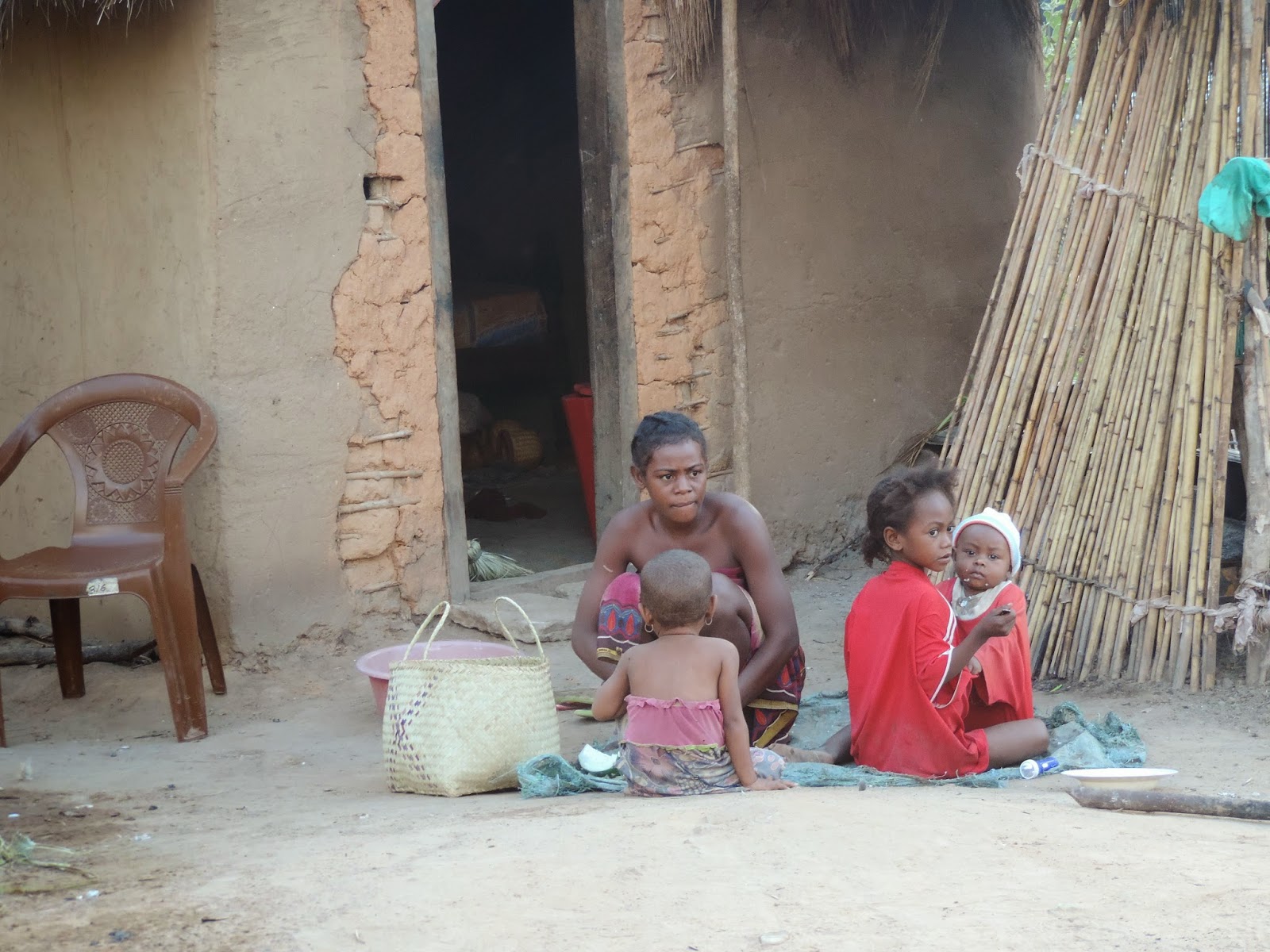
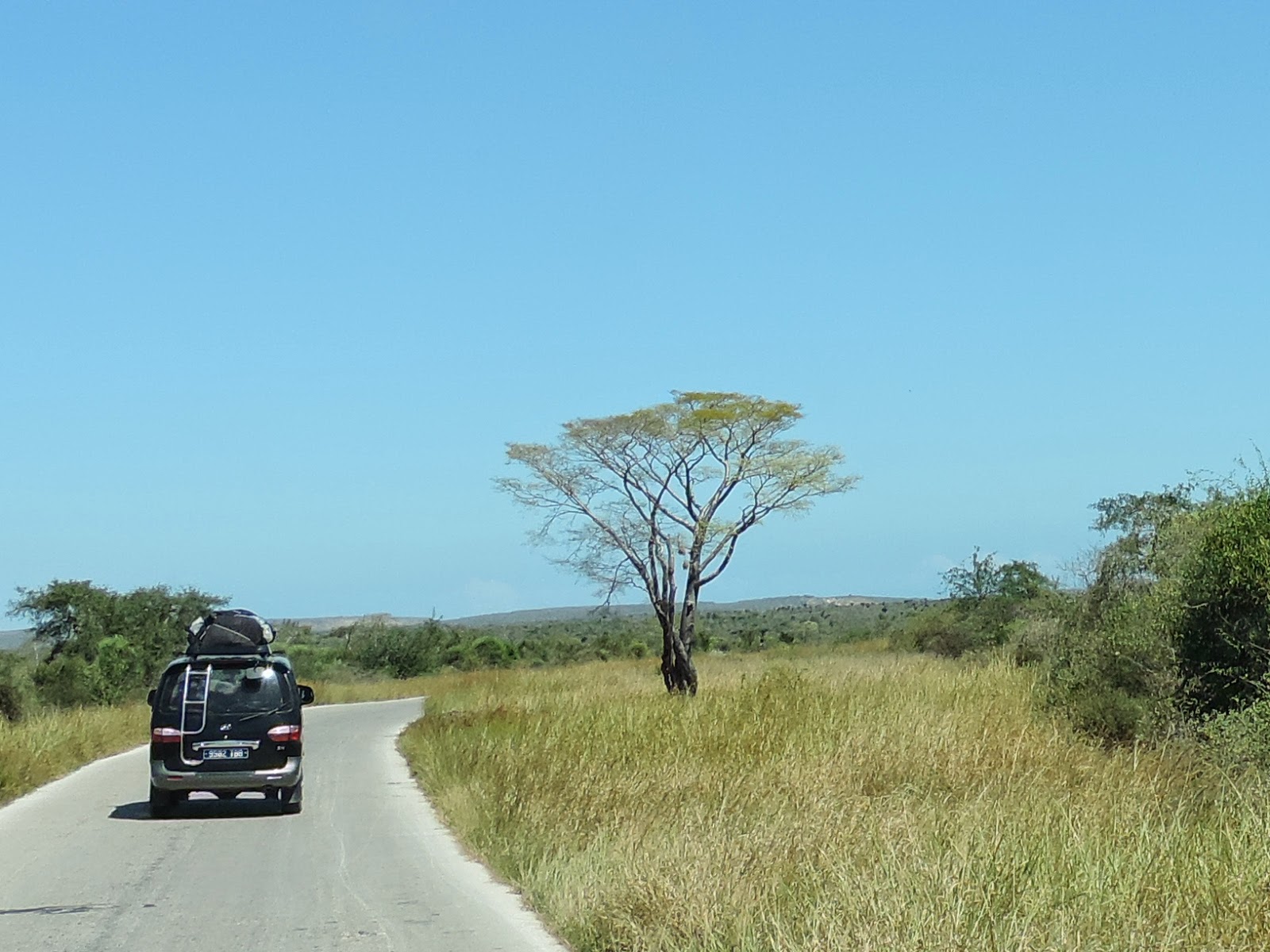
The cool temperature of the highlands and the fertile rice fields of its valleys have given way to a spiny wasteland. We are approaching the end of National Route 7 in the southwest of Madagascar just above the Tropic of Capricorn. Driving at a leisurely tempo, Clement, my guide, is humming and singing softly the words to the traditional folk songs from the CD in the player which we bought several days ago. As usual, I am watching the landscape and the people along the road, snapping an occasional picture, when I become aware that I feel frightened. It is an odd sensation I have had before on trips and arises when I am too far away from the safety of the world I know. As if Clement senses my anxiety or he suddenly feels his own, in his gentle Malagasy-English accent, he articulates what I see. "Sad, very sad" he laments and makes first a clicking sound with his tongue and says "The people have no water."  Along the desolate road I see locals, mainly children, pushing carts loaded with 20 gallon jugs. Some appear at first like ghosts out of the shimmering heat, miles from the nearest house or community. They are headed for tiny dark red mud or straw huts, which are clustered in small groupings around a charcoal burner in order to deliver an essential which I have taken for granted. I reach into the pocket of the passenger side door and pull out my plastic bottle of "Eau Vive" and take a swig. The water is warm. The car thermometer says its 29 C outside. I eagerly anticipate the sighting of the ocean, which I feel by its different color and texture will help soothe my mood  and, when over a bluff  it comes into view, I realize I'm looking west and homeward. I flash back to a vision of my childhood. I'm standing above Torrance Beach in Southern California. The sky is bright and cloudless and I am looking at the blue of the water to the horizon. It seems endless, which is both exciting and a little unnerving. Here the section of ocean before me is called the Mozambique Channel. I'm told it is 400 kilometers wide before it washes up against the east coast of Africa. I push away the thought and, for a moment, preferred the chance to see the familiar distant outline of Catalina Island.

Saturday, April 19, 2014

Posing for the Camera?


My hat goes off to wildlife photographers. That's the way I feel this afternoon after spending several hours with a guide to find lemurs in the Ramofana Rainforest Preserve in Eastern Madagascar. This morning under leaden skies and a light, humid mist, Eliaza, my 25 year old guide, took me on the "short" two hour trek through what he referred to his tribe's native land. Running ahead of us was his "spotter", a sixteen year old local youngster wearing a recycled t-shirt, ill-fitting pants and cheap rubber sandals. The trail descended quickly into a gorge and crossed over, using a rickety bridge a roiling, rain-swollen, chocolate-colored river. I was well outfitted with rain gear and waterproof shoes but the red mud began to splatter over my clothing as we hiked steeply up the other side. I had said to myself that I had needed a workout, after the day before's long car ride, but began to feel out-of-breath, miserable and sweaty. I seriously wondered if the quest to just see some "big-eyed" animal would be worth the effort. Then the spotter suddenly appeared from around a bend and began gesticulating and whispering in Malagasy. With that, my guide moved with agility and quietly off the trail and urged me to follow him upwards into the undergrowth to wend through densely packed trees, vines ferns and lianas. With my camera swinging wildly from my neck and my pack, like a giant barnacle, attached to my back, I squeezed and strained my way almost vertically for several hundred yards to a place where the spotter almost magically reappeared. He pointed to the canopy almost directly above me, as my guide announced proudly that we had come upon a family of rare Edward's Sifaka lemurs. I fumbled for my camera, adjusted settings and saw, tucked peacefully on a branch, a beautiful black and white furry mass. I began to focus and almost immediately the damn thing left its perch and proceeded gracefully, and with amazing precision, to swing and leap from branch to branch further up the hill. I grabbed hold of wooden vines to help me climb onward and was cautioned to avoid certain thorny trunks. Finally we caught up with the our quest who was joyously munching on ripe guava fruit. As I reached for my camera, I felt a strange tickling pain in the hollow between my thumb and forefinger. There, attached to my skin, was a small black leach who had decided to join in the adventure. As I pried the "sucker" loose and began to bleed, the sifaka, which I was told was the male, was joined by the female and a baby. Without as much as a warning, they split up suddenly, with one of them leaping within ten feet of me. I grabbed my camera and shot wildly. Instantly I saw that I had captured some amazing streaks of light and nothing that even resembled a body of an animal. I cursed my existence and my lack of camera skill and again slipped and slithered my way through leaves, mosses, branches and wet goo to a new location. Finally I achieved a certain degree of composure and, from a decent angle, spied clearly the "wily" male. I aimed, saw a dark object on my screen with the white light of the sky behind it, and pressed the shutter. Upon review of the picture, I had snapped nothing more than a black silhouette. It was a humbling and another in a string of perplexing moments. Finally though, I had some luck and modest success which I hope the above photo demonstrates.

I don't know how people who tote tripods, cameras with giant lenses and a crapload of equipment do it. All I know, this kind of eco-tourism experience is intensely educational, often exhausting, and, best of all, thrilling. To achieve top-quality moments sometimes requires effort and, as I sit here now, showered and relaxed, I feel blessed to have lived through another fulfilling day on this journey.

Thursday, April 17, 2014

Snippets of Scenery


Maybe I should have pushed myself out the door of my comfortable hotel and experienced something of the nightlife of the small, poor, bustling city, where the driver and I have stopped. However, I got excited when I discovered good internet connection in my room and rationalized greedily that I should do a post before it becomes impossible as we head south. The truth of the matter was that I simply didn't feel tonight like going through the hassle of walking on pock-holed streets and sidewalks in the darkness amid a throng of local folks to look for that memorable moment, all the while being hassled by rickshaw pullers and street hawkers. It'a not like a backpacking-wearing, camera-toting, older white guy goes unnoticed. Besides,on rare occasions, it can be dangerous.

People have asked me to share scenery pictures to get a sense what Madagascar looks like. I find fulfilling this request most challenging, since it is a country about 3/4 the size of California, and, like it, has vastly different climactic zones. So far I have been in the capital Antananarivo, an eastern rainforest, and today, the beginning of the south. Within these zones alone, I have seen much diversity.

The first photo is from a prominent mount in the center of Tana, the short name for the capital. It shows the sports complex, which was built and paid by the Chinese allegedly as part of a deal to allow Asian business interests to buy up the county's entire bauxite industry. Behind it  is the monument in the lake commemorating independence from France in 1961. I'll spare close-up city scenes which, as you can imagine, show much poverty, a subject I have intentionally avoided in my posts so far.

The second, third and fourth photo shows the landscape transitioning to fertile highlands. I have oodles of pictures of people harvesting the fields and orchards. It is Fall here and vegetables and grains, such as corn and rice, are drying on mats everywhere.

The fifth and sixth photos show  the primary rainforest  It has towering trees, dense undergrowth and great lemur habitat.

As you can see by the brevity of my comments, I have run out of steam. My eyes are heavy and I have reached a point where I can barely type. I hope this  has helped give you some visual idea of this amazing country. I will do my best to furnish more the next time. Thank you all for your loving encouragement and good night!