Saturday, April 3, 2010

High Fives!


The above photos show the WVA students working on the Amizade classroom project in Petersfield, Jamaica.

Tonight their school is in a big basketball tournament in the United States and millions of people will be watching this "Final Four" event. The real heros of the day in my estimation are those who are before you, a team of students dedicating their time and energy to help disadvantaged people from a vastly different culture. For this we should salute the "Mountaineers".

I only have a few minute to post this evening. I will have no connectivity on Easter Sunday and Monday is a national holiday in Jamaica, so I hope to find you on Tuesday. Wednesday is a travel day when I return to the U.S. and head for the Navajo Nation in Arizona.

Thursday, April 1, 2010

A little of this and that.


My photos today have no central theme. This morning our Amizade group toured a sugar cane factory. It was such an intense experience to watch the cane stacked,washed, ground, separated, heated, squeezed and transformed in brown sugar. I saw mountains of sugar, bagged and loaded onto trucks for foreign markets. I have so many thoughts about sugar I hardly no where to begin other than I think it is a terrible product, but more on that some other time. Rather than showing one of the hundred pictures I took of the plant, I liked this last photo of a plant worker resting. It was at least a hundred degrees in the factory, it had an indescribable, noxious odor, and was noisy as hell.

After the tour, the group went to the larger town for some shopping. I left the group and strolled down to the chaotic market. I have so many photos of foods and vendors, but chose this one of a pickup truck bed, because it lumped together in one big pile many of the local foods. How many can you identify?

The top picture of a sign on the seawall of the nearby town, Savanna al Mar, caught my fancy. Like most places, this Jamaican town lacks public bathrooms. I would be cautious and reluctant to use them, even if there were any, but when you have to go, well you have to go. Travelers often tell one another bathroom horror stories and, so far, I've avoided sharing any on my blog. Relieving yourself in any town for a tourist unaccustomed to ruder accomadations is always a challenge. Anyway I walked over to the wall to see the beautiful blue Carribean and unfortunately it wasn't the sea air that caught my attention. So much for civic messages!

Wednesday, March 31, 2010

Unseen Jamaica


It might have been easier to continue posting about the Amizade WVU students' progress on the classroom which was started yesterday, but instead I wanted to show some quiet scenes of the surrounding countryside which shows a Jamaica not found in flashy tourist brochures.

The top two pictures are taken on the main highway that connects Montego Bay with the Southern and Western part of the island where I presently am. What is significant here is that the area is mountainous, tropical, and rather unpopulated. Unlike Tanzania, the street is paved and not clogged with a stream of people pushing or carrying all kinds of items on their heads. The lady in the top photo is not carrying water but is wearing a large yellow sun hat to contrast her hot pink dress. Everyday the temperature has been in the high 80's with some serious humidity, so if you're not a heat lover, I suggest you travel elsewhere.

The third photo shows the landscape around the corner from the housing tract where I live. The empty carts are used to transport sugar cane, which can be seen in the background. This cane was planted in January and will be harvested next year at this time, when it is over three times as tall.

The last photo is of a little beer stand near my lodging. I'm not sure when it opens or if it opens. Such spots dot my road and, in the evening, has patrons socializing, drinking or loudly pounding dominos on the counter during lively games.

Tomorrow I promise to "people" my post, but please understand, I have not yet found the proper opportunity to snap a photo of a serious dredlocked Rastafarian, and may avoid such an encounter for the sake of, let's say,disgression. I like you guys, but.....................!

Tuesday, March 30, 2010

Makin' Jamaica Magic


Yesterday I went to the airport at Montego Bay to meet 15 students from West Virginia University who arrived to begin a weeklong program at the Amizade site in rural Petersfield, Jamaica. For me this is the fourth location where I am lucky enough to immerse myself in a different culture and also am priveleged to watch young American students participate in a worthy project benefitting the world's disadvantaged.

The top picture, snapped early this morning, shows a handful of the volunteers at the Galloway Basic School. Over the next week these WVers will help a mason and carpenter work on building a new classroom. Today though, it was time to meet the children. For some of the volunteers, this is their first trip outside of America and, for others, it is their first time living amidst third world people. Any stiffness, that may appear in their postures as the group is introduced to some first graders, quickly melted away.

The second photo shows one of many similar scenes I witnessed this morning. Hidden in the circle of lovely children is an Amizade volunteer, whose hair is being braided. Every American student could be seen playing with or tutoring these children and thereby becoming more comfortable in this new environment. These children are, for the most part, from families of the working poor, that spend long hours in the sugarcane fields or factories. They were so appreciative of the attention given them by these "strangers.".

The third photo shows the underpinnings of a new classroom on which the Amizade students will provide labor. Through the relentless lobbying effort of our host, the Community of Clubs, the Jamaican Education Ministery provided the initial funds for new classrooms for this school. Yet this space quickly became immediately insufficient and overcrowded. This exceptionally impoverished community, like other sites I have witnessed throughout the world, depends entirely on the resources of its own community in the form of money, materials and volunteers to provide its children with quality education.

By the way, in the background, is an amazing tree. It is the Silk Cotton or Ceiba Tree and is one of the largest trees in the Carribean. Myths abound regarding these trees, as our Jamaican host explained. The silken fibers which hang freely when the fruit ripens catch the souls of the dead. To fell one of these behemoths may precipitate your untimely demise.

My mind is so full of thoughts and impressions formed by the people I meet, I could write all night, but I'll spare you. Suffice to say, this part of my adventure has again such rich moments.
My blog gives me an opportunity to preserve some these moments, to share them, and to remind me later on that this trip was not a dream.

Sunday, March 28, 2010

Jamaica, mahn!

For the next several days I'll be posting from Jamaica and showing you a world that is rarely seen by tourists. I am 40 miles South of the luxury hotels of Montego Bay in a small community called Petersfield. The sign on the wall is written in Patois, the mixture of English, French and Creole that the local people speak. I catch a few words but for, the most part, I understand little.

It has been quite a transition from Africa through Hong Kong and New York to here. For brief moments I feel like I'm in Tanzania because all the people are black and the landscape is quite tropical like in Karagwe, but the similarities end rapidly. The Jamaican tempo and mannerisms are remarkably different. I feel a much more agressive mood in the air and there is virtually no interest in me as an American.

This is a big island 150 miles South of Cuba is separated by miles of ocean from the rest of the Carribean nations. After it received independence in 1962, it suffered economicallywith the caprice of the sugar cane market, then controlled entirely by foreigners. Now tourism and the receipt of moneys sent from relatives in America make up the bulk of Jamaica's income.

When visiting last night with a high school history teacher, I asked about Jamaica's most important historical figures. He believed that no one has made a greater impact on Jamaica more than Bob Marley. Ask anyone and they'll tell you that Marley put Jamaica on the map. Jamaica is all about its music. It is blasted from cars, stores and people are dancing and singing at all hours. The knowledge that their music is adulated throughout the world has given this former colony of slaves a powerful identity and pride found nowhere else in the region.

I also have learned that these Jamacians are not docile people like those I met in Tanzania. Men and women are equal and express themselves strongly. The Jamaican women are really tough too. Woe the guy who tries to rough up a woman. He's likely to be beaten up himself. .

On Monday all the students arrive and by Tuesday we'll all be involved in a building project of some kind. Until then hey mahn, you be good now, eh?

Thursday, March 25, 2010

Masai People of the Serengeti/Ngorogoro


I am posting tonight from New York after my 15 hour plane flight from Hong Kong. Tomorrow morning I leave for Jamaica and will not know how much connectivity I will have from Amizade site.

For the past several days I have shown pictures from my Tanzania safari through the Serengeti. There is still so much I want to share of this aspect of the adventure, especially photos of Olduvai Gorge where Louis and Mary Leakey found the 1.75 million year old Australopithicus. Also I must still show photos of the 8th Wonder of the World, The Ngorogoro Crater, 18 miles from rim to rim, teeming with amazing animals, including rhinos, living safely in a deep natural pocket, lost in time.

Then again what would a trip through the Serengeti be without pictures of its living human residents, the Masai. Tribal life in Tanzania was discouraged and basically eliminated with independence in 1962, but traditional values and rural life, ujamaa, was embraced as a key teaching by Julius Nyerere, the country's founder.

The Masai have retained their tribal identity and many live in mud huts in small circular enclosed villages. Those folks, living within the park, survive entirely on raising cattle or goats, which are allowed to roam freely in certain sections. Agriculture is not permitted. The middle photo is of a cattle herder who spoke some Swaheli and asked for food rather than money. These people barter a lot among one another. By the way every marriage involves a dowry of cows.

The bottom picture of the two women was taken in a town outside of the park. Many Masai have left the confines of rural village living and have sought their fortune in nearby communities. These ladies sold me two hand-woven beaded bracelets and were amused by my horrible accent and wild gesticulations.

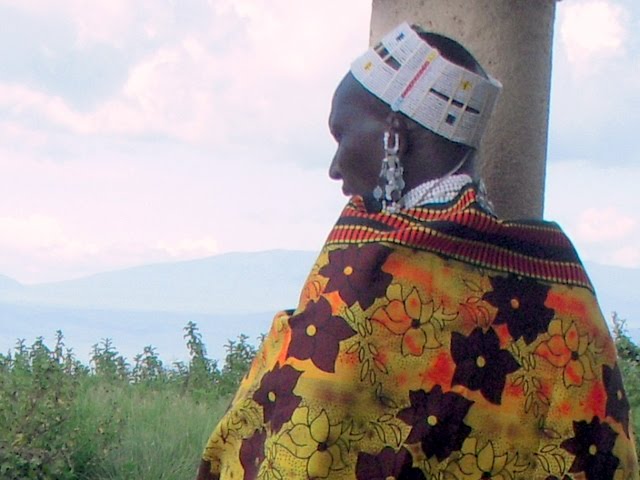
I snapped the top picture and included it for you to see the earings and hats worn by Masai women. Along the road the men and women pride themselves in the most colorful dress that I had seen on my travels. The women wear long silver necklaces and chokers, plus huge earings.

My mind takes me back tonight to this world that is already beginning to feel distant. I ,of course, know nothing of these strange people. Being there reminded me of scenes in Joseph Conrad's Heart of Darkness or the village in Lord Jim. Such remote places are disappearing. Herds of camera-toting tourists descend on these people every day and as cultures colllide, well, you know the rest.

Wednesday, March 24, 2010

Leopard spotted?


A guide radioed that he had seen a leopard asleep on some rocks on a hillock not far from the road. When we arrived, the beautiful cat awoke, stretched, jumped down, hid in some tall grass for a bit and then, amazingly enough, crossed the road in front of us, intent on giving the gawking tourists the slip. We followed him slinking away through high grass using high-powered binoculars for quite along time until he disappeared entirely from view. The driver theorized the leopard had a lone tree about a 1/2 mile in the distance as his goal and decided that we should have a look. We drove off the jeep trail and proceeded to roll slowly across the grassland.

The second photo shows that we found our "friend" asleep on a high branch, pooped from his long walk, sheltered from the heat, and resting, before an evening of work. He opened his eyes for a moment, flicked his tail, and ignored our presence.

I chose to include the third photo to give you a sense of the vast open space of the Serengeti. Please look carefully at the third branch above the bend. That stick you see is the leopard's tail. From this vantage point, prey can be spotted for miles. Of course there is so much wildlife, especially gazelles and impalas, that I am sure the leopard does not go often hungry. In fact any number of animals might seek the shade under this tree. By the way, don't you think it might be a nice place to have a picnic?